The problem isn't the tool. It's the cognitive model it's built upon.
Real-world data on the impact of traditional Knowledge Bases in enterprise organizations.
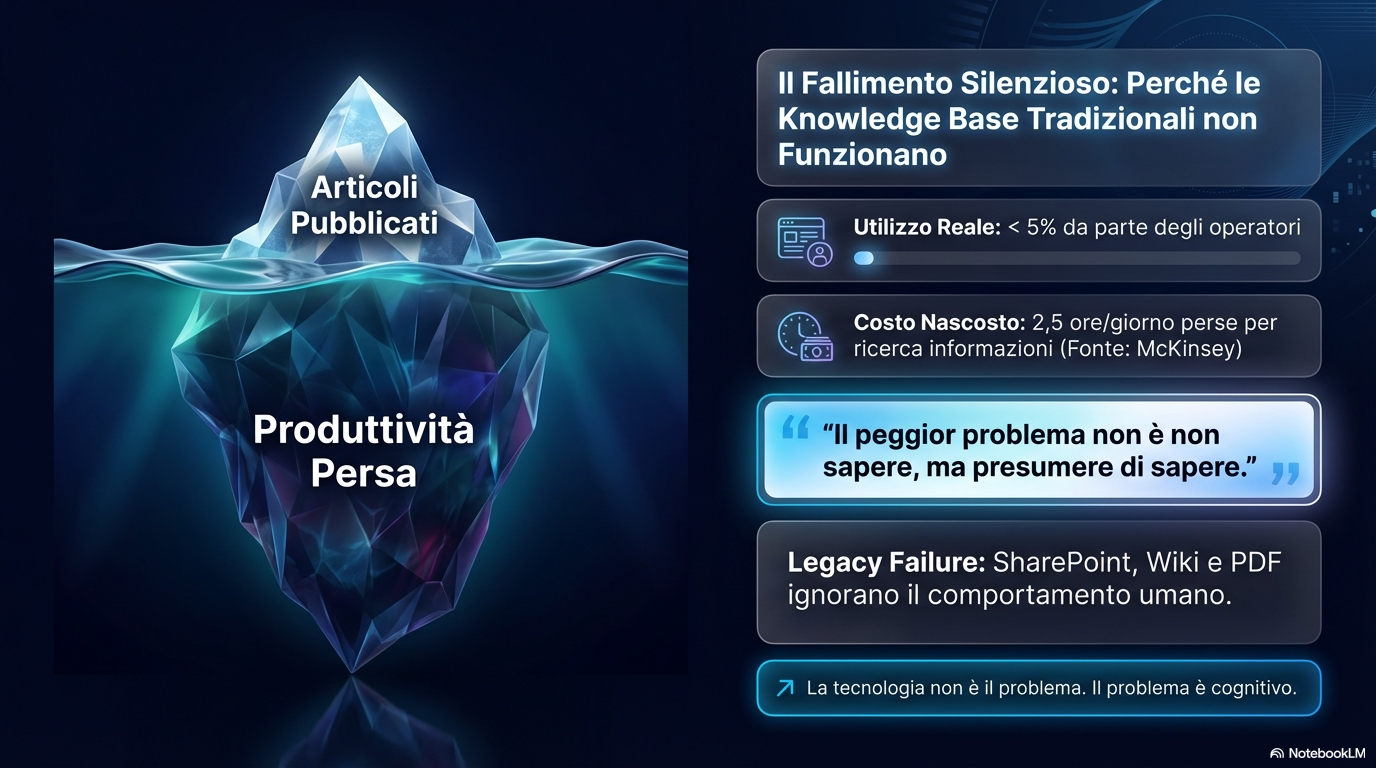
Most organizations have a Knowledge Base. Very few actually use it. The real usage rate is below 5% — yet the problem is rarely measured because no one monitors whether technicians actually consult the KB before resolving a ticket.
The visible surface of the problem — outdated articles, fruitless searches — is just the tip of the iceberg. Below the waterline lies a structural cost that impacts productivity, service quality, and staff retention.
Technology isn't the problem. SharePoint, Wiki, Confluence, shared PDFs: all of these tools ignore how the human brain learns and retrieves information under operational pressure.
A predictable pattern that repeats in every organization. The outcome is always the same: abandonment.
Phase 1 — The enthusiastic creation. The company invests in the KB. A dedicated team writes articles, creates documentation. The launch looks promising.
Phase 2 — The gradual abandonment. Documenting takes time. No one is incentivized to do it. Technicians have tickets to close, not articles to write. The KB freezes.
Phase 3 — The silent obsolescence. Procedures change, systems get updated, but the KB stays frozen. Technicians consult it, find outdated information, and lose trust.
Phase 4 — The workaround. Technicians develop informal channels: internal chats, sticky notes, "ask the expert colleague." Knowledge becomes implicit, personal, volatile once again.
Phase 5 — The abandonment. The KB becomes a graveyard of documents. It exists on paper, but no one uses it. The investment is lost.
The economic impact of a dysfunctional Knowledge Base runs far deeper than it appears.
An operator spends an average of 2.5 hours per day searching for information. Across a team of 20, that amounts to 50 hours daily — over 6 FTE equivalents lost to non-productive activities. McKinsey estimates 31% of productivity evaporates.
Without a reliable KB, the same mistakes are made by different people at different times. Each repeated error carries a direct cost (resolution time) and an indirect cost (damage to service reputation, SLA breaches, avoidable escalations).
Each new technical resource costs between €15-30k in onboarding. Without a functioning KB, newcomers depend entirely on colleagues — who slow down their own work to act as mentors. Time to operational autonomy extends by weeks.
With annual turnover of 15-25% in L1/L2 teams, knowledge walks out the door every quarter. The expert technician who leaves takes years of undocumented experience with them — informal procedures, workarounds, context that no document captures.
Traditional tools ignore how the human brain learns, remembers, and applies operational procedures under pressure. A technician resolving a critical incident doesn't have time to read a 15-page document — they need the right answer, in the right format, at the right moment.
But there's an even more insidious problem: the expert technician assumes they already know. In corporate environments, rules change constantly — updated procedures, new policies, infrastructure changes. No system today tells them "something has changed." The technician operates with obsolete knowledge, convinced they're doing the right thing.
The worst problem isn't not knowing — it's assuming you already know.
Three scientific pillars grounded in neuroscience, motivational psychology, and algorithmic governance.